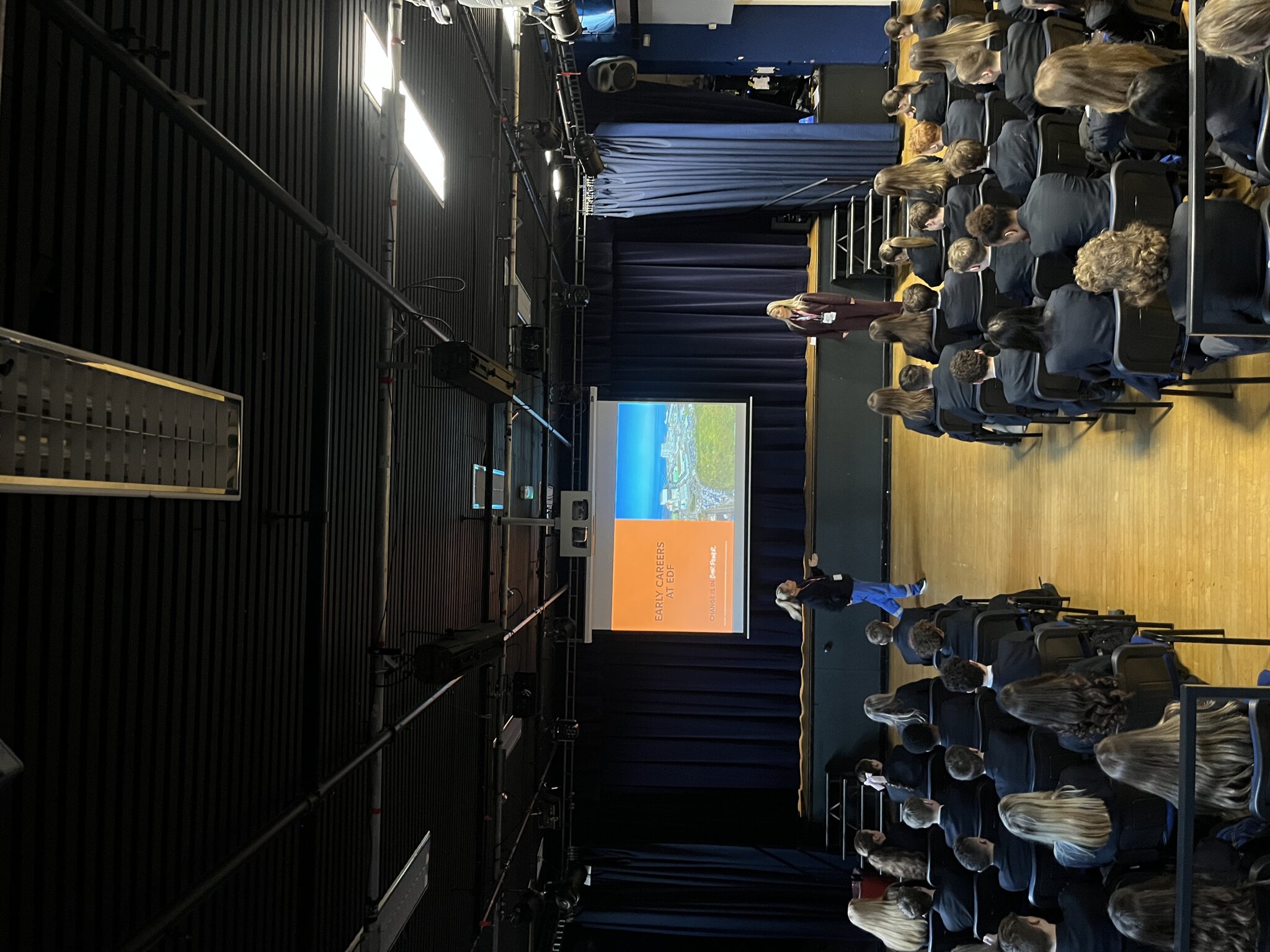
Year 10 students benefited from a highly informative careers assembly delivered by representatives from EDF, Britain's largest generator of low-carbon electricity. The session provided a fantastic, in-depth look at the diverse and essential energy sector and the incredible career paths available within a major company like EDF.
An Industry of Opportunities
The assembly focused on the sheer breadth of roles within the energy industry, moving far beyond the traditional idea of engineering. Students learned that the drive towards a Net Zero future requires talent across a vast range of disciplines, including:
- Engineering & Technical Roles: Nuclear Engineering, Maintenance and Operations, Electrical, and Civil Engineering (often offered as Degree Apprenticeships).
- Science & Environment: Health Physics, Chemistry, and Environmental Management.
- Business & Corporate: Project Management, Project Controls, Business Administration, Finance, Supply Chain, and Commercial roles.
- Digital & IT: Cyber Security, Data Science, and IT Support.
This demonstrated that whether a student is interested in STEM (Science, Technology, Engineering, and Maths) or Business and Project Management, there is a vital role for them in the future of the UK's energy supply.
Essential Skills for Your Future Applications
A key takeaway from the EDF team was the valuable advice shared on application and recruitment processes. The information is highly relevant for any future apprenticeship, university, or job application.
EDF uses a skills-based hiring approach, focusing on a candidate's potential and behaviours, not just academic grades. Students learned the importance of demonstrating:
- Strengths and Motivation: Focusing on what they enjoy doing and are good at (e.g., problem-solving, teamwork).
- Key Behaviours: Showing they are reliable, resilient, and collaborative.
- Transferable Skills: Highlighting skills gained through school projects, part-time work, or extracurricular activities.
Students were strongly encouraged to research the company's values (like sustainability and safety) and show how their own experiences align in their applications and interviews. They also detailed the multi-stage application process, which typically includes an online application, online assessments, a video interview, and a final assessment centre.